
Understanding Trypsin and Carboxypeptidase B, GMP Grade

Recombinant Trypsin and Carboxypeptidase B GMP Grade for biopharmaceutical manufacturing
Our GMP Grade recombinant Trypsin and Carboxypeptidase B (CpB) are animal-free proteases that deliver exceptional quality and safety for highly regulated biopharma manufacturing processes. Manufactured under ISO 13485:2016 compliance and suited for GMP production settings, these high-purity enzymes ensure the reproducibility required for critical applications, including cell detachment for cell and gene therapy, viral activation in vaccine production, and the precision cleavage and trimming necessary for mature insulin production. These specific proteases are essential tools for the modification of therapeutic proteins and the optimization of large-scale biopharmaceutical manufacturing.
- Recombinant Trypsin: High-purity endoprotease expressed in Pichia pastoris (Trypsin ≥ 90%, ≥ 70% β-trypsin, ≤ 20% α-trypsin). Animal-free to eliminate TSE/BSE risk.
- Recombinant Carboxypeptidase B: Tailored for insulin processing with exceptional purity (<0.005 % trypsin contamination) and high specific activity (> 210 U/mg protein).
- Product quality: Manufactured under a certified ISO 13485:2016 quality management system, extended quality documentation available to support regulatory submissions.
Advantages of choosing Roche GMP Grade Trypsin & Carboxypeptidase B
Our recombinant Trypsin and Carboxypeptidase B offer the following benefits:
- Endotoxin-free:
Ensure superior safety with Pichia pastoris as an expression system that minimizes endotoxin levels. - Animal-free:
Eliminate the risk of viral or prion contamination using a fully recombinant manufacturing platform. - Product quality:
Rely on products manufactured under a certified ISO 13485:2016 quality management system
- Lot-to-lot consistency:
Eliminate batch-to-batch variability and secure highly reproducible performance through tightly controlled manufacturing processes and a proven track record of continuous, narrow-specification batches. - Proven heritage and expertise:
Leverage more than 20 years of Trypsin and Carboxpeptidase B biomanufacturing experience from Roche CustomBiotech. Originally developed to secure Roche Pharma's own high-value therapeutics.1
Applications GMP Grade Trypsin & Carboxypeptidase B (CpB)
Trypsin, rec., GMP Grade and Carboxypeptidase B (CpB), rec., GMP Grade are used for these main applications:
Insulin production
Precision cleavage (Trypsin) and final C-terminal trimming (CpB) of proinsulin precursors into mature, active insulin.
Vaccine manufacturing
Used for the detachment of adherent cell lines and as a viral activator.

Cell and gene therapy
Gentle cell detachment for high-value modalities like CAR-T.4,5
Therapeutic antibodies
Processing and modification of antibody fragments.2,3

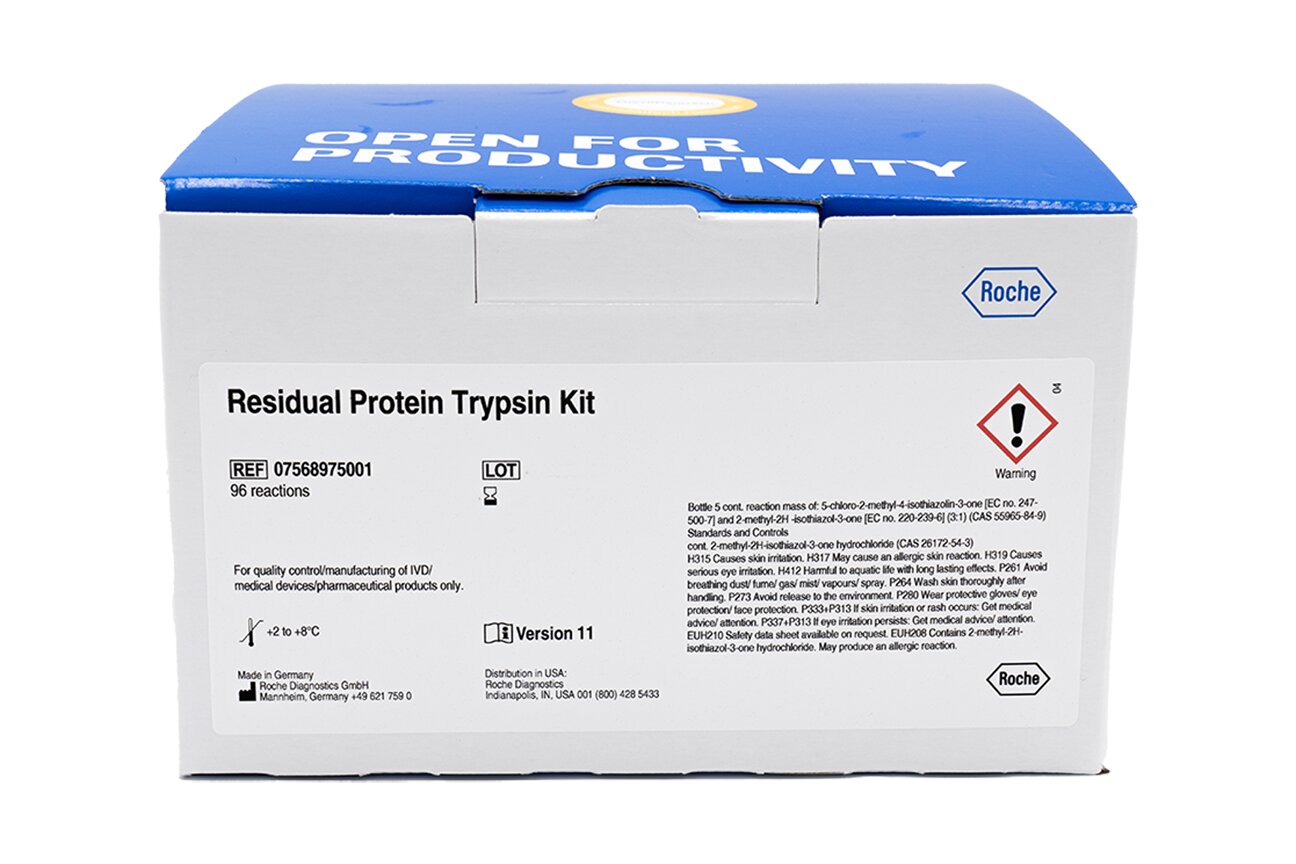
Product details Trypsin, rec., GMP Grade and Carboxypeptidase, rec., GMP Grade
| Trypsin, rec., GMP Grade | Carboxypeptidase B, rec., GMP Grade | |
Manufacturing grade |
GMP Grade | GMP Grade |
| Expression host | Pichia pastoris | Pichia pastoris |
| Origin | Animal-free | Animal-free |
| Specific activity | ≥ 180 U/ml (with Chromozym TRY) | ≥ 210 U/mg (with Hippurylarginine) |
| Purity | Trypsin ≥ 90%, ≥ 70% β-trypsin, ≤ 20% α-trypsin | ≥ 85% (RP-HPLC) |
| Form | Clear, colorless to slightly yellowish solution | Clear, colorless to slightly yellowish solution |
| pH value | 2 +/- 0.5 | 7.5 - 8.5 (at +25°C) |
| Activation | Autocatalytic activation | Activated via in-house Roche Trypsin, rec., GMP Grade |
| Storage temperature | -15°C to -25°C | -15°C to -25°C |
| Catalog number | 03 358 658 103 (3.5 MU), 06 369 880 103 (1 g) | 03 358 682 103 (30 KU) |
Technical documents
- Certificate of Analysis
ISO 13485:2016 certificate for Roche Diagnostics GmbH Roche Life Science, Penzberg, Germany
- Extended quality documentation:
Statements covering residual solvents, elemental impurities, biological contamination risk, GMP Grade, viral safety, allergens and additives, and nitrosamines.
Statements about packaging details and test methods. Certificates:
Origin (including explicit TSE/BSE statements confirming animal-free status) and stability (including specific shipping and transportation details).- Various other documents available upon request.
Compliance
- Both recombinant products are manufactured under a certified ISO 13485:2016 quality management system.
Production utilizes recombinant expression in the eukaryotic yeast Pichia pastoris, ensuring the entire fermentation, purification, and formulation process is entirely free of animal-derived materials.
The animal-free profile guarantees the complete elimination of TSE/BSE contamination risks.
Storage and shipping
- Shipping: Trypsin and Carboxypeptidase B, rec., GMP Grade are recommended to be shipped at -20°C.
- Storage: Both enzymes must be stored at freezing temperatures between -15°C and -25°C immediately upon arrival.
- Dilution: Please contact us for information on storage and handling after dilution.
- Manufacturing: Developed and continuous production at Roche's state-of-the art biotechnology center in Penzberg, Germany, supporting supply chain stability.

References
- Popp O, et al. Development of a pre-glycoengineered CHO-K1 host cell line for the expression of antibodies with enhanced Fc mediated effector function. mAbs. 2018;10(2):290–303. doi:10.1080/19420862.2017.1405203
- Hsieh M-C, et al. Enhanced ADCC activity of a C-terminal lysine variant of an IgG1 antibody driven by N-linked MAN5 glycan. Antibodies. 2025;14(4):89. doi:10.3390/antibodies14040089
- Mayr K, et al. Comprehensive multidimensional liquid chromatography-mass spectrometry for the characterization of charge variants of a bispecific antibody. Anal Chem. 2023;95(50):18379–18387. doi:10.1021/acs.analchem.3c03848
- Viode K, et al. Evaluation and optimization of different digestion strategies for in-depth proteomic characterization of residual host cell proteins in rAAV-based gene therapy products. Anal Chem. 2026.
- Eugenin EA, et al. Gap junctions coordinate the propagation of glycogenolysis induced by norepinephrine in the pineal gland. J Neurochem. 2019;151(6):680–693. doi:10.1111/jnc.14866